Breaking The Binaries
This past semester, I took an honors core seminar, which is a combination of two classes that have similar topics and relate to one another. This seminar combined Gender, Identity, and Literature with Women and Creativity and it was called "Breaking the Binaries." The phrase "breaking the binaries" is something that's been explored all throughout the courses and is going to be the main focus here.
To give some context, when we talk about the word "binary," we mean two things that are opposites. Examples of binaries include man vs. woman, reason vs. emotion, heterosexual vs. homosexual, etc. Typically it's clear that one is superior to the other. My main focus here is on gender and sexuality, so the two main binaries are man vs. woman and heterosexual vs. homosexual. Throughout our history and even in present day, we see that females and people within the LGBTQ community are treated as inferiors because they're different than the "normal" heterosexual male. Gender and sexual orientation discrimination has been a common topic throughout the semester and it's important to learn and understand that this is a serious issue to this day. Throughout this course, it's been shown in many ways how this is an issue through texts we've read, artists we've looked at, and films we've watched.
One of the main texts that shows this is a memoir titled The Other Side of Paradise by Staceyann Chin. This is the story of Staceyann Chin's life and what it was like to grow up as a mixed race lesbian-identified female in Jamaica. She faced multiple forms of oppression including classism, racism, sexism, and, later in her life, homophobia. She was abandoned by her parents and lived with her grandmother at the start of the memoir. Then throughout the story, she was living with different family members who constantly looked down on her and judged her for things such as her race because being half-Chinese, she was lighter than her cousins and relatives. She was also treated poorly for being a woman after she was sexually assaulted by one of her cousins. Then later in the story, we see her face homophobia and there was a point where she was gang raped for being an open lesbian. I really like this memoir because it shows that there are people out there like Staceyann Chin who face many different forms of oppression because of falling into just about every minority. I think it's an excellent piece of work and something that should be taught in schools.
Another example is a documentary film we watched titled A Jihad for Love. This film was essentially about Islam and homosexuality, which is a big issue. It was very eye-opening and I'd imagine that it's educational to those who aren't fully aware of the issues LGBTQ Muslims face as they face much more oppression and discrimination because of their religious beliefs. So I think the film is a great example of a work that's important because it spreads awareness and educates people on an issue that is serious and current.
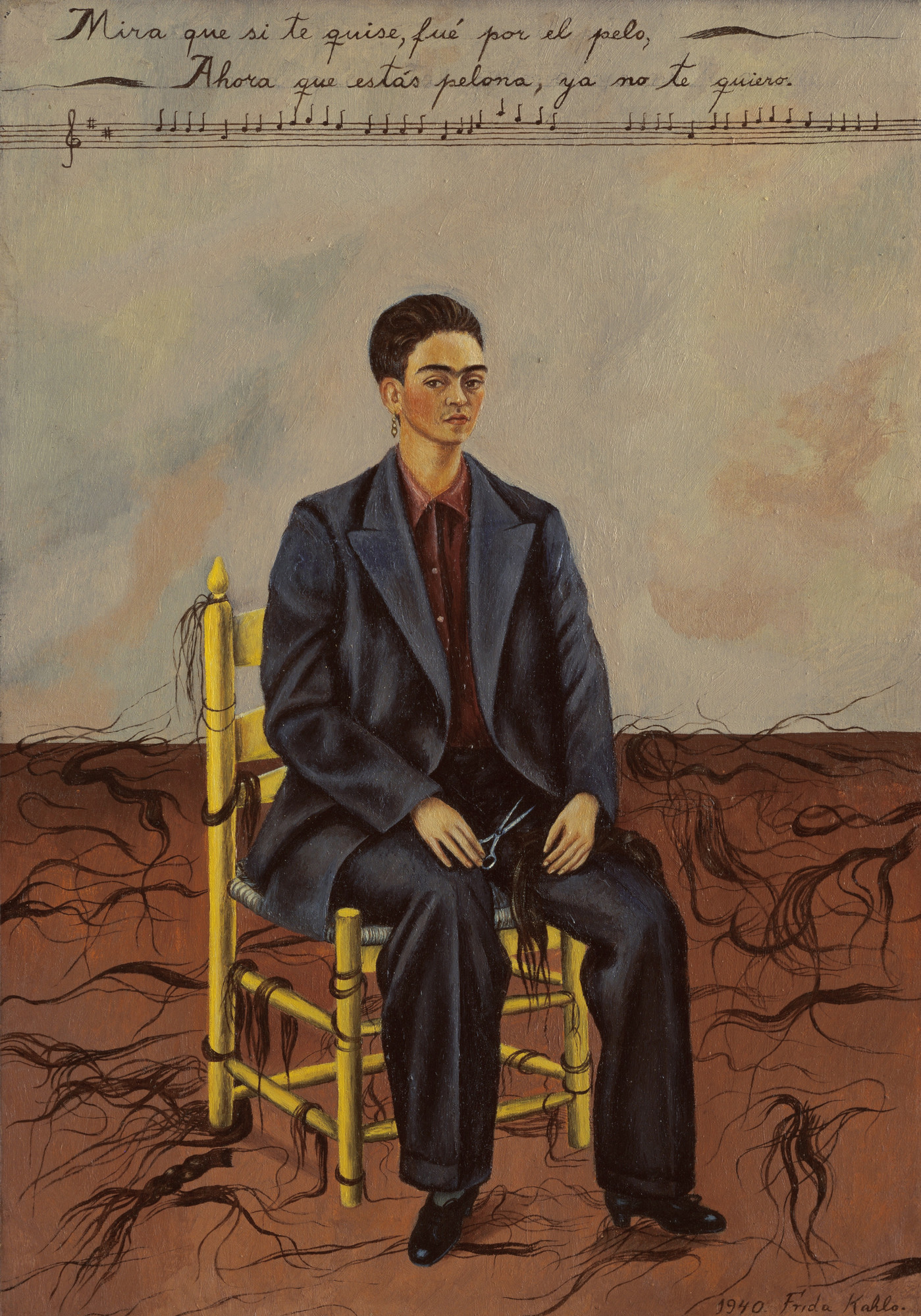
When we think of the phrase "breaking the binaries," we should think about what it means to break those boundaries between male and female, heterosexual and homosexual, white and black, and whatever other binaries we can think of. When it comes to gender, we have the binary of male vs. female as well as masculinity vs. femininity. Masculinity is typically associated with males and femininity is typically associated with females and that's what's considered "normal" in our society. But I believe that a correlation between gender identity and how one presents themselves is not necessary. Not all males have to be masculine and not all females have to be feminine. There can be a mix of feminine males and masculine females. We can look at an artist like Frida Kahlo who appears masculine in a lot of her self-portraits, especially the "Self-Portrait with Cropped Hair" where she has short hair and is wearing an oversized men's suit, which challenges the whole men = masculinity and women = femininity correlation. Here we have a female who appears masculine because that is how she wants to present herself, which I'm arguing is an okay thing.
It's similar in the graphic memoir Fun Home: A Family Tragicomic by Alison Bechdel where two of the main characters, Alison and her father, present themselves and act in ways that society wouldn't expect based on our idea of gender roles. In the story, Alison is a lesbian and she tends to look masculine enough to the point where one might not be able to tell right off the bat that she is a female and that's how she identifies. At the same time, her father is mostly concerned about the appearance of their house and all their decorations. In our society with gender roles, housework is typically not a concern for the males in the household and it's usually associated with females. Again, I think this is an okay thing. I don't think there needs to be a correlation between gender identity and gender roles/presentation, nor do I think there needs to be a distinct difference between male and female.
Everything we've looked at this semester has helped enhance my knowledge on what it means to "break the binaries" and I think this is something that should be taught everywhere. I don't think there need to be distinctions between male and female and that there need to be gender roles associated with each. I think both gender and sexuality can be fluid and not something that is fixed or static. That's how I view the phrase "breaking the binaries" and it was a very interesting topic to explore over the course of the semester. This is why I think seminars and courses like this are important. I learned a lot, and I know others can as well.
To give some context, when we talk about the word "binary," we mean two things that are opposites. Examples of binaries include man vs. woman, reason vs. emotion, heterosexual vs. homosexual, etc. Typically it's clear that one is superior to the other. My main focus here is on gender and sexuality, so the two main binaries are man vs. woman and heterosexual vs. homosexual. Throughout our history and even in present day, we see that females and people within the LGBTQ community are treated as inferiors because they're different than the "normal" heterosexual male. Gender and sexual orientation discrimination has been a common topic throughout the semester and it's important to learn and understand that this is a serious issue to this day. Throughout this course, it's been shown in many ways how this is an issue through texts we've read, artists we've looked at, and films we've watched.
One of the main texts that shows this is a memoir titled The Other Side of Paradise by Staceyann Chin. This is the story of Staceyann Chin's life and what it was like to grow up as a mixed race lesbian-identified female in Jamaica. She faced multiple forms of oppression including classism, racism, sexism, and, later in her life, homophobia. She was abandoned by her parents and lived with her grandmother at the start of the memoir. Then throughout the story, she was living with different family members who constantly looked down on her and judged her for things such as her race because being half-Chinese, she was lighter than her cousins and relatives. She was also treated poorly for being a woman after she was sexually assaulted by one of her cousins. Then later in the story, we see her face homophobia and there was a point where she was gang raped for being an open lesbian. I really like this memoir because it shows that there are people out there like Staceyann Chin who face many different forms of oppression because of falling into just about every minority. I think it's an excellent piece of work and something that should be taught in schools.
Another example is a documentary film we watched titled A Jihad for Love. This film was essentially about Islam and homosexuality, which is a big issue. It was very eye-opening and I'd imagine that it's educational to those who aren't fully aware of the issues LGBTQ Muslims face as they face much more oppression and discrimination because of their religious beliefs. So I think the film is a great example of a work that's important because it spreads awareness and educates people on an issue that is serious and current.
When we think of the phrase "breaking the binaries," we should think about what it means to break those boundaries between male and female, heterosexual and homosexual, white and black, and whatever other binaries we can think of. When it comes to gender, we have the binary of male vs. female as well as masculinity vs. femininity. Masculinity is typically associated with males and femininity is typically associated with females and that's what's considered "normal" in our society. But I believe that a correlation between gender identity and how one presents themselves is not necessary. Not all males have to be masculine and not all females have to be feminine. There can be a mix of feminine males and masculine females. We can look at an artist like Frida Kahlo who appears masculine in a lot of her self-portraits, especially the "Self-Portrait with Cropped Hair" where she has short hair and is wearing an oversized men's suit, which challenges the whole men = masculinity and women = femininity correlation. Here we have a female who appears masculine because that is how she wants to present herself, which I'm arguing is an okay thing.
It's similar in the graphic memoir Fun Home: A Family Tragicomic by Alison Bechdel where two of the main characters, Alison and her father, present themselves and act in ways that society wouldn't expect based on our idea of gender roles. In the story, Alison is a lesbian and she tends to look masculine enough to the point where one might not be able to tell right off the bat that she is a female and that's how she identifies. At the same time, her father is mostly concerned about the appearance of their house and all their decorations. In our society with gender roles, housework is typically not a concern for the males in the household and it's usually associated with females. Again, I think this is an okay thing. I don't think there needs to be a correlation between gender identity and gender roles/presentation, nor do I think there needs to be a distinct difference between male and female.
Everything we've looked at this semester has helped enhance my knowledge on what it means to "break the binaries" and I think this is something that should be taught everywhere. I don't think there need to be distinctions between male and female and that there need to be gender roles associated with each. I think both gender and sexuality can be fluid and not something that is fixed or static. That's how I view the phrase "breaking the binaries" and it was a very interesting topic to explore over the course of the semester. This is why I think seminars and courses like this are important. I learned a lot, and I know others can as well.
First welcome back Adrian glad to see u here
ReplyDelete